Artificial intelligence has quickly become part of everyday working life. From automated meeting notes to intelligent data analysis, many businesses are integrating AI tools to improve efficiency and productivity. But with this rapid change has also come a growing concern: AI anxiety in the workplace. For many employees, the rise of AI brings uncertainty about job security, changing responsibilities and the future of their roles.
For HR teams and people managers, understanding and addressing AI anxiety in the workplace is becoming an important part of supporting employee wellbeing. The key challenge is not simply introducing new technology, but helping teams feel confident, informed and involved as these changes unfold.
In this blog, we’ll explore what AI looks like in the modern workplace, why it can feel intimidating to employees, and how HR leaders and managers can support their teams through this period of transformation.
What AI Looks Like in the Modern Workplace
AI is no longer a futuristic concept. Over the past few years, it has quietly become embedded into many of the tools employees already use every day. Back in 2022 the UK government found that 15% of all businesses have adopted ai technology.
Across industries around the world, AI is being implemented to streamline processes, improve decision-making and support innovation. Rather than replacing entire roles, most AI tools are designed to assist employees with repetitive tasks, freeing up time for more strategic or creative work.
Some of the most commonly used workplace AI tools include:
- AI writing assistants that help draft emails, reports or marketing content
- Data analysis tools that quickly identify patterns and trends within large datasets
- Customer service chatbots that handle routine enquiries
- Automated scheduling systems that organise meetings and manage calendars
- AI-powered HR platforms that assist with recruitment screening or workforce analytics
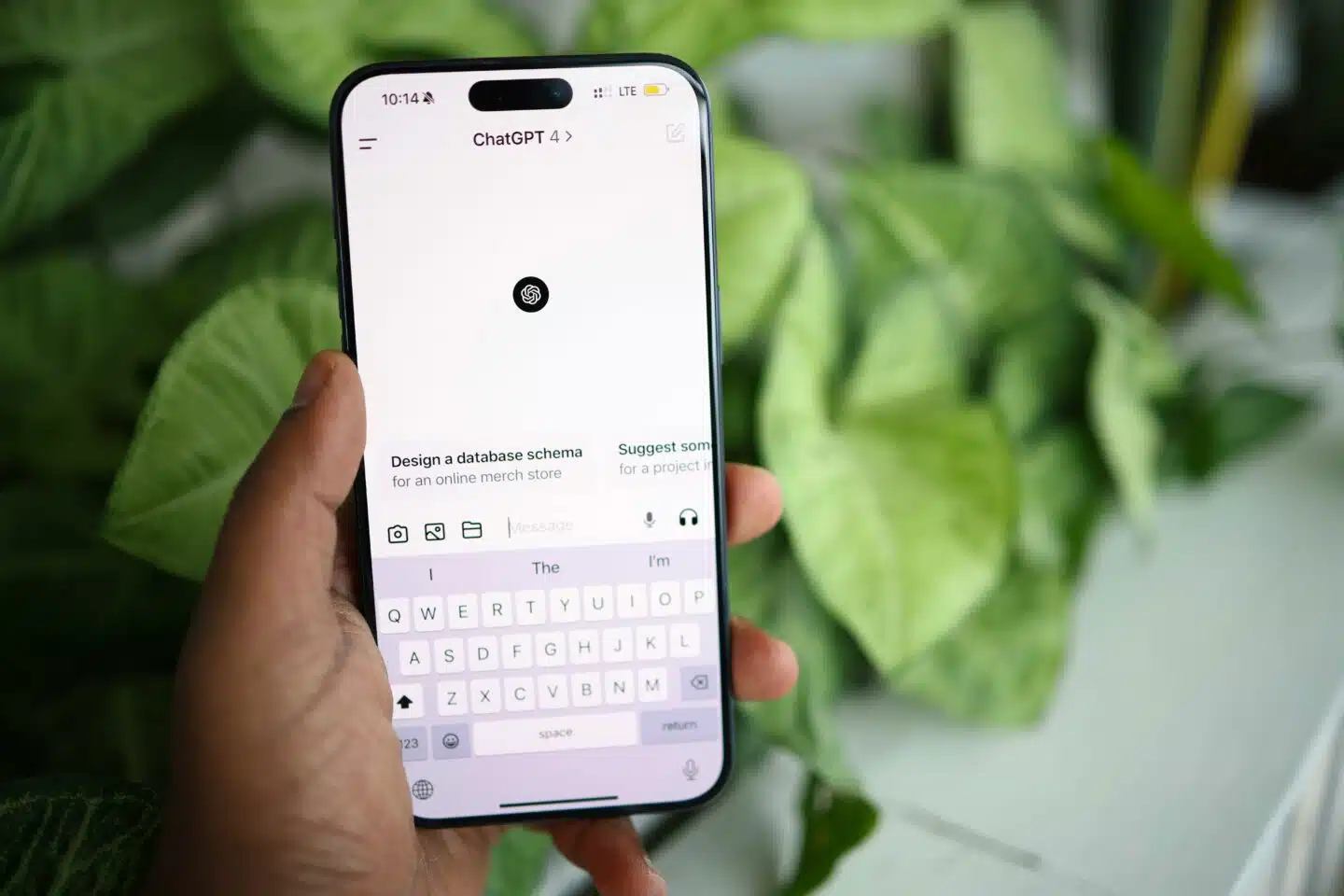
The widespread adoption of generative AI tools such as ChatGPT, alongside productivity platforms like Microsoft Copilot and Google Gemini, has accelerated the pace at which AI is entering workplaces.
For many companies, the goal is simple: improve efficiency, reduce manual workload and support employees with smarter tools. However, while businesses see opportunity, employees may see uncertainty.
Why AI Feels Scary to Employees Right Now
Despite the benefits AI can bring, it’s completely understandable that many employees feel uneasy about these developments. The conversation around automation and job disruption has been ongoing for years, and recent breakthroughs in AI have intensified those concerns. Some of the most common fears driving AI anxiety in the workplace include:
Fear of job displacement
Employees may worry that AI will eventually replace their roles or reduce the need for human workers. 26% of employees surveyed fear that AI will replace their job.
Lack of understanding
Many employees simply don’t know how AI works or how it will affect their role, which can lead to uncertainty and speculation.
Rapid pace of change
Technology is evolving quickly, and employees may feel they are struggling to keep up.
Loss of control or autonomy
Some employees worry that decisions could increasingly be made by algorithms rather than people.
Pressure to adapt quickly
Employees may feel anxious about needing to learn new tools or develop new skills in a short space of time.
When these concerns aren’t addressed, AI anxiety in the workplace can affect morale, productivity and engagement. That’s why proactive communication and reassurance from leadership are so important.

Common Misconceptions About AI
Part of reducing anxiety around AI is helping employees understand what the technology actually can and cannot do.
A few common misconceptions include:
“AI will replace all jobs.”
In reality, AI is far more likely to transform roles rather than eliminate them entirely. Many jobs will evolve to include new responsibilities that work alongside AI tools.
“AI is always accurate.”
AI systems can make mistakes and require human oversight. Critical thinking and professional judgement remain essential.
“AI removes the need for human creativity.”
Quite the opposite. AI often enhances creativity by helping employees brainstorm ideas, analyse insights and execute projects faster.
Ultimately, AI works best as a supporting tool, not a replacement for human expertise.
As expert in the field and keynote speaker, Livia Bernardini explains:
“In a world where AI can scale information at extraordinary speed, human judgement becomes even more valuable. Not instead of data. Alongside it. As data gives signals, intuition helps us interpret them and pay attention to the signals that may still be too subtle for algorithms to detect.”
This perspective is important. AI may process information quickly, but human insight, empathy and judgement remain irreplaceable.

How Employers Can Support AI Anxiety in the Workplace
For HR teams and people leaders, the challenge is ensuring employees feel supported throughout the transition. Here are several strategies that can help businesses address AI anxiety in the workplace and build trust with their teams.
1. Develop Clear AI Policies
Employees need clarity around how AI will be used within the organisation. Creating clear policies can help answer important questions such as:
- When and how AI tools should be used
- Data privacy and security considerations
- Where human oversight is required
- Ethical guidelines around AI-generated work
Having these frameworks in place helps remove uncertainty and creates a sense of structure.
2. Be Honest and Transparent
One of the most effective ways to reduce AI anxiety in the workplace is simple: communicate openly.
Share why the company is adopting AI, what the goals are, and how it may impact roles. Avoid vague messaging and instead provide practical examples of how tools will support employees.
Transparency builds trust.
3. Keep Communication Open
Managers should actively invite conversations about AI rather than waiting for concerns to surface. Psychological safety begins with the ability to speak openly and honestly about ai in a productive way. Encourage employees to ask questions such as:
- How will AI affect my role?
- What new skills might I need?
- What tasks will AI help automate?
Creating safe spaces for discussion helps prevent rumours and misinformation from spreading.
4. Give Employees a Voice
When implementing new technology, involving employees in the process can make a significant difference. Consider:
- Running internal surveys on AI adoption
- Creating pilot programmes where teams test new tools
- Hosting feedback sessions after implementation
When employees feel heard, they are far more likely to support change.
5. Embed AI into Learning and Development
Confidence grows when people feel equipped with the right knowledge. Only 14% of employees have received training to address how AI will change their roles.
Providing training opportunities, whether through workshops, online learning or peer mentoring, can help employees understand how to use AI effectively. Rather than feeling threatened by technology, employees begin to see it as a skill that enhances their professional development.
6. Demonstrate the Strengths of AI Tools
Sometimes the best way to reduce anxiety is simply to show how helpful AI can be. For example:
- Demonstrate how AI can automate repetitive tasks
- Show how it can improve data analysis
- Highlight time savings in everyday workflows
When employees see tangible benefits, their perception of AI often shifts from fear to curiosity.
7. Celebrate Human Skills
One of the most powerful ways to combat AI anxiety in the workplace is to reinforce the value of human strengths. Skills that remain uniquely human include:
- Emotional intelligence
- Creativity
- Strategic thinking
- Relationship building
- Leadership and collaboration
These qualities are essential in every business and they can’t be replicated by algorithms.
8. Address Fear of Job Displacement
If employees worry about job security, leaders should address those concerns directly rather than avoiding the conversation.
Explain how roles may evolve and highlight opportunities for upskilling or role development. Reframing AI as a tool that supports employees rather than replaces them can significantly reduce anxiety.
9. Celebrate Success Stories
Sharing positive examples of how AI has helped teams can build confidence across the organisation. This might include:
- Employees who used AI to complete projects faster
- Teams who improved productivity with automation
- Creative work enhanced by AI insights
Success stories help turn abstract ideas into real-world benefits.

The Future of AI in the Workplace
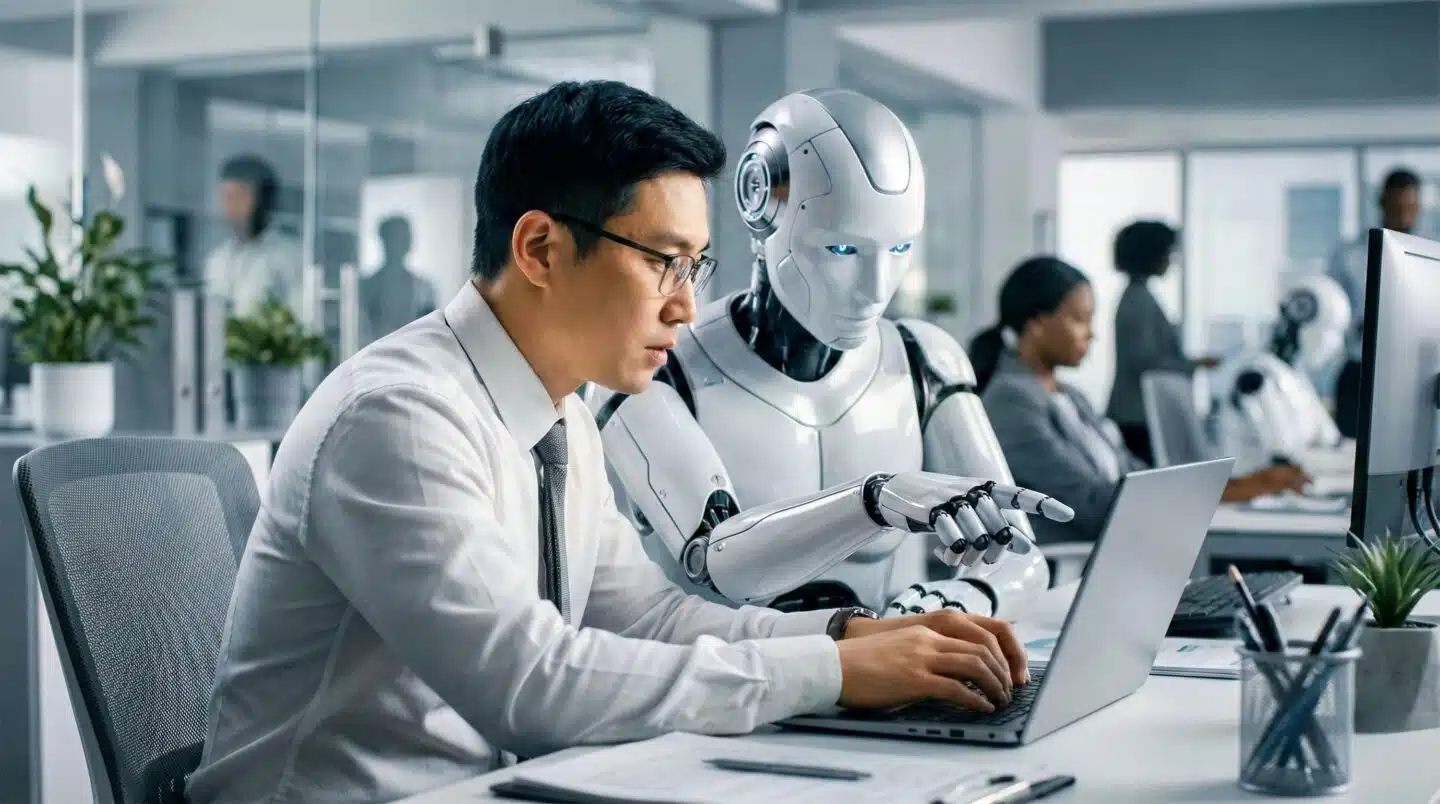
AI will continue to evolve, and its role in the workplace will almost certainly grow. Over the next 3 years, 92% of businesses are planning to increase their investment in AI. However, the future of work is unlikely to be defined by humans versus machines. Instead, it will be shaped by how effectively people and technology collaborate.
Forward-thinking organisations are already acknowledging that AI adoption must go hand in hand with employee support, communication and development.
When businesses take a people-first approach to innovation, they can transform AI anxiety in the workplace into something far more positive: excitement about new possibilities.
Final Thoughts
AI is changing how we work, but change doesn’t have to create fear. With the right leadership approach, businesses can create an environment where employees feel informed, supported and empowered.
For HR teams and people managers, addressing AI anxiety in the workplace is about more than technology. It’s about trust, transparency and helping employees understand the role they will continue to play in an AI-powered future.
By focusing on communication, learning and collaboration, companies can ensure that AI becomes a tool for enhancing human potential, not replacing it. And when employees feel valued and confident in their evolving roles, businesses benefit from stronger engagement, innovation and long-term success. Need help in supporting employee engagement? Speak to our friendly team below about our range of incredible rewards: