Happy employees are good for business. It sounds simple enough, doesn’t it? But how do you actually know whether your employees are happy at work? And more importantly, what can you do if they’re not? Understanding how to measure employee happiness is becoming an increasingly important part of HR strategy, helping businesses create workplaces where people feel valued, supported and motivated to do their best.
The tricky part? Happiness isn’t always easy to spot, and just because nobody’s complaining doesn’t necessarily mean everyone’s happy. That’s why regularly checking in with employees and understanding how they’re feeling can make such a difference.
Why is employee happiness important?
When people feel positive about their jobs, they’re more likely to be motivated, engaged and committed to the business they work for. And when employees aren’t happy? Businesses may start to notice the effects through higher staff turnover, reduced productivity and lower morale.
In fact, research highlighted by Reward Gateway and the London School of Economics found that happier employees were 10–12% more productive and 30% less likely to leave their roles. While happiness isn’t the only factor behind these outcomes, the findings certainly make a strong case for taking it seriously.
So, what are some of the biggest benefits of having a happy workforce?
1. Better employee retention
Recruiting and training new employees takes time, money and resources. And while some staff turnover is inevitable, losing talented people because they’re unhappy at work is something businesses should be trying to avoid.
Employees who feel appreciated, supported and satisfied in their roles are more likely to want to stick around. By regularly measuring happiness, HR teams can identify potential frustrations before they become reasons for employees to start looking elsewhere.
2. Improved productivity and motivation
Think about the last time you really enjoyed working on something. Chances are, you felt more motivated to put in the effort and produce your best work. The same principle applies in the workplace.
Research from the University of Oxford found that happy employees were 13% more productive. Employees who feel positive about their working environment are often better placed to stay focused, collaborate with colleagues and contribute new ideas. Of course, happiness doesn’t mean every working day needs to be exciting. Everyone has difficult days! It’s about creating the right conditions for employees to feel motivated and supported over the long term.
3. A stronger workplace culture
Workplace culture doesn’t just mean company values written on a wall. It’s shaped by everyday interactions, management styles and how employees are treated.
When people feel comfortable speaking up, sharing ideas and being themselves at work, it helps create a more positive and inclusive environment.
Learning how to measure employee happiness can reveal whether your company culture is actually living up to what you want it to be.
4. Happier customers
There’s also a connection between how employees feel and the experience they deliver to customers. Whether it’s a customer service representative resolving an issue or a sales team building relationships with clients, employees who feel supported and motivated may be better equipped to provide a positive customer experience.
Looking after your people can therefore have benefits that extend well beyond your own workforce.
How to measure employee happiness: 6 practical methods
So, we’ve established why employee happiness matters. But how do you go about measuring something as personal and subjective as happiness?
The good news is that you don’t need a complicated system or a huge HR budget to get started. Here are six practical ways to learn how to measure employee happiness:

1. Run regular employee happiness surveys
Employee surveys are one of the simplest and most effective ways to understand how people feel about their workplace. They give employees an opportunity to share honest feedback about everything from their workload and relationships with colleagues to management support and overall job satisfaction.
Rather than relying solely on one big annual survey, consider introducing shorter quarterly or monthly pulse surveys. These can help you spot changes in employee sentiment throughout the year and respond to issues more quickly.
Some useful employee happiness survey questions include:
- On a scale of 1–10, how happy do you currently feel at work?
- Do you feel valued and appreciated for your contributions?
- Do you feel supported by your manager?
- Are you satisfied with your current work-life balance?
- Do you feel comfortable sharing your opinions and concerns?
- What is one thing we could change to improve your experience at work?
Our tip: Keep surveys short, make responses anonymous where possible and explain how the feedback will be used. Employees are much more likely to participate when they trust the process and believe their opinions will make a difference.
2. Make the most of one-to-one meetings
Managers have a bigger influence on employee engagement than you might think. According to Gallup, managers account for 70% of the variation in engagement between teams. That’s why regular check-ins and supportive conversations are so important when it comes to understanding how employees are really feeling.
And we’re not just talking about discussing deadlines and performance targets. Managers should make time to ask questions such as:
- How are you feeling about work at the moment?
- Is there anything making your job unnecessarily stressful?
- Do you feel you’re getting enough support?
- Is there anything you’d like to do more or less of in your role?
The key is creating an environment where employees feel comfortable being honest without worrying about negative consequences. Remember, not everyone will feel confident raising concerns in a group setting, so these individual conversations can be particularly valuable.
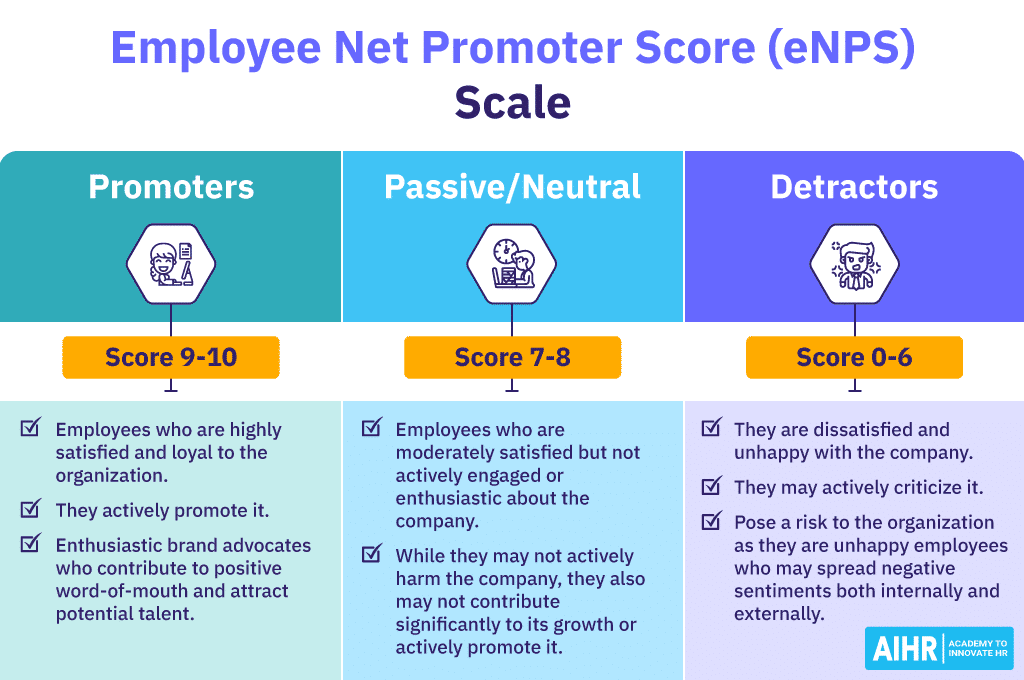
3. Track your Employee Net Promoter Score (eNPS)
If you’re looking for a simple metric to track over time, Employee Net Promoter Score (eNPS) is worth considering. It measures how likely employees are to recommend your company as a great place to work.
Employees are asked one straightforward question:
On a scale of 0–10, how likely are you to recommend our company as a place to work?
Responses are then divided into three groups:
- Promoters (9–10): Employees who are highly likely to recommend your organisation.
- Passives (7–8): Employees who are generally positive but less enthusiastic.
- Detractors (0–6): Employees who are unlikely to recommend your company.
Your eNPS is calculated by subtracting the percentage of detractors from the percentage of promoters, giving you a score between -100 and +100. For example, if 60% of employees are promoters and 20% are detractors, your eNPS would be +40.
It’s a useful way to monitor employee sentiment over time, although it shouldn’t be your only measure of happiness. Someone might recommend their workplace for its career opportunities or salary without necessarily feeling happy in their day-to-day role.
4. Monitor employee turnover and absenteeism
Not all signs of employee unhappiness come directly from surveys. Sometimes, your existing HR data can provide useful clues about how employees are feeling.
For example, an increase in staff turnover could suggest that employees are becoming dissatisfied with aspects of their working environment. Similarly, changes in absence patterns may highlight issues worth exploring, such as excessive workloads, stress or a lack of support.
However, it’s important not to jump to conclusions. Employees leave businesses or take time off for all sorts of reasons, many of which have nothing to do with workplace happiness. Instead, look for patterns and use these metrics alongside employee feedback to build a clearer picture.
Exit interviews and stay interviews can also be particularly useful. While exit interviews help you understand why people are leaving, stay interviews give you the chance to discover what makes employees want to remain with your business. And that information can be incredibly valuable.
5. Encourage continuous employee feedback
One of the biggest mistakes businesses can make is treating employee feedback as something that only happens once or twice a year. Happiness can change quickly, particularly during busy periods, business changes or when employees take on additional responsibilities.
Creating opportunities for continuous feedback helps HR teams stay connected to what’s happening across the business. This could include anonymous suggestion boxes, regular team discussions, employee forums or simple check-ins following major workplace changes. You could even introduce a quick weekly mood check, asking employees to describe how they’re feeling using a simple rating scale.
The important thing is to make giving feedback feel like a normal part of working life rather than a formal exercise.

6. Measure how valued and recognized employees feel
Feeling appreciated can play a big part in how happy employees are at work. After all, nobody wants to feel like their hard work goes unnoticed. That’s why it’s worth including questions about recognition and appreciation when measuring employee happiness. For example:
- Do you feel your contributions are noticed?
- Does your manager regularly acknowledge your achievements?
- Are you satisfied with the rewards and benefits available to you?
- Do you feel your hard work is appreciated by the wider business?
The answers can help you understand whether your existing employee reward and recognition initiatives are having the desired impact. And remember, recognition doesn’t always need to involve a big financial reward, there are plenty of great alternatives. Sometimes a genuine thank you, a personal message or a small gesture of appreciation can make someone’s day.
How often should businesses measure employee happiness?
If you’re wondering how to measure employee happiness effectively, consistency is one of the most important things to get right. An annual employee engagement survey can provide useful insights, but a lot can change in twelve months.
An employee might feel perfectly happy in January but be struggling with their workload by April. If you’re only asking for feedback once a year, there’s a good chance you won’t spot the problem until much later. For many businesses, quarterly pulse surveys offer a sensible starting point, supported by regular one-to-one meetings and ongoing opportunities for feedback. You could consider the following approach:
| Frequency | Suggested activity |
| Weekly or fortnightly | Informal manager check-ins and team conversations |
| Monthly | Short wellbeing or happiness pulse checks |
| Quarterly | Employee happiness surveys and review of key trends |
| Annually | A more detailed employee engagement survey and review of HR strategy |
There’s no one-size-fits-all approach, so choose a frequency that works for your business without overwhelming employees with constant surveys. It’s also worth keeping your core questions consistent. That way, you can compare results over time and see whether the changes you’re making are having a positive impact.

What should you do with your employee happiness results?
Collecting feedback is one thing. Actually doing something with it is where the real value lies. There’s little point asking employees how they’re feeling if their responses disappear into a spreadsheet and nothing changes. Once you’ve gathered your results, here are a few steps worth taking:
Look for recurring themes. Are employees consistently raising concerns about workloads, communication or career progression? Identifying common issues can help you decide where to focus your attention.
Compare results over time. Rather than getting too caught up in one score, look at whether happiness levels are improving or declining. Where privacy allows, comparing results across departments can also help identify areas that need additional support.
Share what you’ve learned. Employees should know that their feedback has been heard. Communicate the key findings, acknowledge any concerns and explain what happens next.
Create a realistic action plan. You don’t need to fix everything overnight. Start by identifying two or three priorities and assigning clear responsibilities and timelines.
Check whether your changes are working. If you’ve introduced flexible working arrangements, improved internal communication or updated your recognition program, use future surveys to understand whether employees are noticing a difference.
And perhaps most importantly, be prepared to hear things you weren’t expecting. Negative feedback isn’t necessarily a bad thing. In fact, it can be one of the most valuable opportunities to improve your workplace.
How can businesses improve employee happiness?
Once you understand how your employees are feeling, the next step is finding ways to make their working experience better. Of course, what makes one employee happy won’t necessarily work for another. Some people value flexibility and work-life balance, while others prefer career development, supportive management or feeling appreciated.
That’s why listening to your workforce should always come first. However, there are a few areas worth considering:
Support work-life balance. Encourage employees to take their annual leave, respect boundaries outside working hours and review workloads regularly.
Invest in development. Give employees opportunities to learn new skills, progress in their careers and take on responsibilities that interest them.
Improve communication. Keep employees informed about company developments and create opportunities for honest, two-way conversations.
Celebrate achievements. Celebrate individual and team successes, acknowledge hard work and make appreciation part of your everyday company culture.
Make rewards meaningful. Think about what benefits make people happy and what your employees would genuinely enjoy receiving, rather than assuming everyone wants the same thing.
That last point is particularly important when it comes to employee reward and recognition. A thoughtful reward can show employees that their efforts are valued, whether it’s celebrating a work anniversary, recognizing an outstanding achievement or simply saying thank you for going above and beyond.
At Virgin Incentives, we’re big believers in the power of experiences to make people feel appreciated. From relaxing spa days and memorable meals out to exciting adventures and weekend getaways, experience-based rewards give employees something special to look forward to. And with flexible gift cards, employees can choose an experience that suits their own interests, making recognition feel that little bit more personal.
Of course, rewards alone won’t solve deeper workplace issues such as poor management or excessive workloads. But when they’re part of a wider employee engagement strategy, meaningful recognition can help reinforce a positive workplace culture.

Final thoughts: A happier workforce starts with listening
Employee happiness shouldn’t be something businesses only think about when turnover increases or engagement scores start falling. By making happiness a regular part of your HR strategy, you can gain a better understanding of what employees value, identify potential issues earlier and make more informed decisions about how to support your people.
And the best part? Getting started doesn’t need to be complicated. A few thoughtful survey questions, regular conversations and a genuine willingness to act on feedback can go a long way. Ultimately, knowing how to measure employee happiness is only the beginning. What really matters is using those insights to create a workplace where people feel heard, supported and appreciated.
Looking for meaningful ways to recognize and reward your employees? At Virgin Incentives, we help businesses celebrate their people with memorable experiences and flexible gifting solutions. Get in touch with our team below to discover how we can support your employee reward and recognition strategy: